• Menu
    • The Schloss
    • The Meierhof
    • Planning Your Stay
    Stay.
  • Menu
    • The State Rooms
    • The Grounds
    • Exhibitions & Events
    • Our History
    • The Sound of Music
    • Friends of Schloss Leopoldskron
    • Salzburg and Surrounding Area
    Explore.
  • Menu
    • Weddings
    • Meetings
    • Film Shoots
    • Eating With Us
    • Experiences & Amenities
    • Experience Gifts
    Occasions.
  • Gallery
  • Book Your Stay
en
de
Book Your Stay

The State Rooms

Architecture, memory, and meaning

01
Introduction

Designed by Scottish Benedictine monk Bernard Stuart, Schloss Leopoldskron reflects a deliberate departure from Salzburg’s dramatic baroque aesthetic. Its compact layout, measured symmetry, and restrained decoration embody classical ideals of balance and proportion - an architecture shaped as much by intellect as by ornament.

For Prince-Archbishop Leopold Anton von Firmian, this was more than style. It was a statement of refinement and ambition – positioning the Schloss within a broader European cultural tradition. Over the centuries, these rooms have absorbed new layers of meaning: artistic reinvention under Max Reinhardt, political rupture during the Nazi era, and renewal as a place of dialogue and exchange.

Today, the State Rooms remain both historic interiors and living spaces – shaped by beauty, complexity, and the stories held within their walls.

02
The State Rooms
Stone, symmetry, and ascent

The Great Hall

The character of Schloss Leopoldskron begins with the stone itself. The staircase is formed from warm-toned marble quarried from the nearby Untersberg mountain – grounding the building literally and symbolically in its landscape.

Above, delicate white rococo stucco by Johann Kleber softens the classical geometry. The ceiling appears almost weightless, its sculpted forms rippling like fabric in motion. Watching over the ascent are statues of Roman emperors Marcus Aurelius and Septimius Severus - figures of intellect, duty, and imperial ambition – reminding visitors that architecture here was always intended to communicate meaning.

Theatrical imagination preserved

The Print Room

When Max Reinhardt purchased the Schloss in 1918, he transformed it into both residence and cultural haven. In this intimate hallway, he installed 69 rare etchings and paintings from the 17th and 18th centuries - scenes of baroque garden theatres, masked performers, and moments from Commedia dell’arte.

Works by artists such as Ferdinando Galli da Bibiena and Jacques Callot reflect the theatrical traditions that shaped Reinhardt’s own immersive productions. Preserved today as part of Austria’s national heritage, each one provides a window into the theatrical traditions that inspired him.

“I wish I had another day to just take in more of this special hotel, read a book in the drop dead gorgeous library, stroll the ground a little more and bask in the awe of the overall ambience”
Trip Advisor review
03
The beating heart of the Schloss

The Max Reinhardt Library

Designed in 1927 and inspired by the Abbey Library of St. Gallen, the Max Reinhardt Library was the creative and intellectual centre of Reinhardt’s life at Leopoldskron. Painted ceiling cartouches, carefully balanced proportions, and a concealed staircase reflect his theatrical imagination.

At its height, the library held some 15,000 volumes - including rare editions, theatre journals, and personally dedicated works. Several Stars of David and Reinhardt’s personal insignia are intricately set into the wooden and brass doors of the Library, symbols that mysteriously survived the Nazi seizure of the Schloss.

Many of Reinhardt’s books were saved and shipped to him in New York before further persecution could destroy them. After wartime misuse and liberation, the library returned to its role as a space of learning and exchange.

Today, it remains a place of reflection - where guests can relax with a book in an antique chair by the window, and where conversations continue long into the evening, a testament to Reinhardt’s deep love of learning, storytelling and human connection.
 

Worlds imagined, histories remembered

The Marble Hall

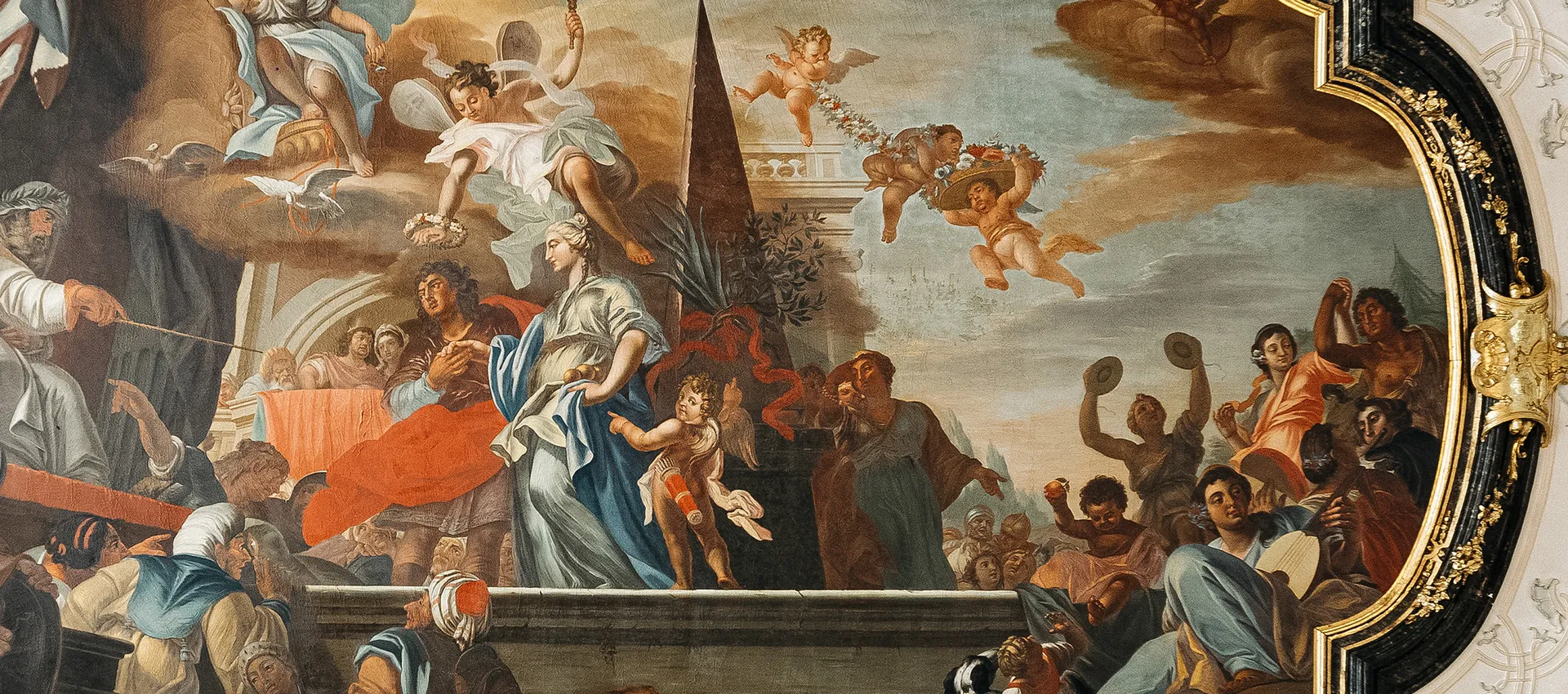
The Marble Hall’s ceiling offers an 18th-century vision of the “four corners of the earth.” Dragons and elephants represent Asia; parrots and monkeys, Africa; llamas and alligators, the Americas; horses and oxen, Europe. Framed within are references to the four elements, the arts, and the stages of life - an ambitious attempt to map human experience across the globe.

At its centre, Salzburg artist Franz Anton Ebner painted the mythological “Marriage of Atalanta,” a tale of love, wit, and divine intervention. The surrounding paintings by Andrea Rensi depict the founding of the Schloss and the lineage of ownership within the Firmian family.

The Marble Hall has also witnessed profound shifts in history. Following the seizure of the Schloss by the Gestapo in 1938, the hall hosted propaganda concerts and elite gatherings. Yet just two years after the war’s end, former enemies met here again to imagine a different future at the first ever Salzburg Seminar. Beauty and rupture coexist in this space – a reminder of how the Great Hall has both endured and been reclaimed.

Faith, devotion, and remembrance

The Chapel

Consecrated in 1744, the palace chapel marks the completion of the Schloss. Dominated by a gilded marble altar, the room is defined by luminous white surfaces and pale stucco ornamentation.

An altar painting by Franz Anton Ebner depicts Mary with the infant Jesus, alongside St. Leopold and St. Rupert - figures central to Salzburg’s religious history. Eleven paintings by Andrea Rensi line the walls and ceiling, conveying key teachings of the Catholic Church.

Though Archbishop Firmian was buried in Salzburg Cathedral after his death, his heart remains interred beneath the chapel floor — a testament to the place he “loved so dearly.”

Theatre, transformation, and reflection

The Venetian Salon

Originally Max Reinhardt’s music parlour, the Venetian Salon is defined by golden wood panels and mirrored walls depicting scenes from Commedia dell’arte, a form of improvised theatre from the 16th Century. Installed in 1930 and purchased from an Italian palazzo, the panels form part of Austria’s protected heritage.

Commedia dell’arte – meaning “comedy of the profession” – was improvisational, satirical, and radically inclusive. It embraced women performers and blurred social hierarchies, celebrating the transformative power of performance. Reinhardt saw it as foundational to modern theatre.

The Venetian Salon provided the inspiration for the exquisitely designed ballroom in the Von Trapp family manor – where Maria first dances with the Captain in The Sound of Music.

Today, the room’s imagery invites deeper reflection. Figures such as Arlecchino – shown with darkened masks or painted faces – were once theatrical conventions, but now prompt larger questions and critical reflection. The Venetian Salon holds past and present in conversation – layered, complex, and evolving.

Elegance in a softer register

The White Salon

Adjacent to the Venetian Salon, the Mansbach White Salon mirrors its proportions but speaks more quietly. A blue-and-gold tiled stove from around 1740 anchors the room, its ornamentation more restrained than its neighbour’s.

Portraits of the Firmian family line the walls, framed by stucco work dating to the palace’s original construction. During Max Reinhardt’s era, the room housed porcelain and glassware used for elegant family meals.

In the post-war decades, it served as a discussion space and staff canteen before being carefully restored. Today, it once again offers cultivated charm for intimate gatherings and small dinners.

Cross-cultural echoes

The Green Salon

With gilded mirrors, hand-painted panels, and filtered light, the Green Salon is one of the Schloss’s most ornate spaces. Commissioned by Max Reinhardt in the 1920s, its decorative scheme draws on the French rococo tradition of chinoiserie - an 18th-century European interpretation of East Asian aesthetics.

This style, once a symbol of aristocratic worldliness, now raises questions of appreciation and appropriation. Reinhardt’s interpretation blended rococo art history with cinematic sensibility, creating a space suspended between homage and illusion.

Three statues of Kuan Yin, the Buddhist figure of compassion, stand within the room. Across centuries and cultures, Kuan Yin’s evolving form - sometimes male, female, or androgynous - speaks to care beyond fixed identity, adding another layer to the salon’s dialogue.

Ideas set in motion

The Red Salon

In this northeast corner room, Max Reinhardt gathered with Hugo von Hofmannsthal and Richard Strauss in 1920 to imagine what would become the Salzburg Festival. The Red Salon was his meeting space – a room where artistic vision moved from conversation to action.

Originally painted dusky pink and laid with what was believed to be Salzburg’s first red carpet, the room reflected Reinhardt’s theatrical sensibility. In 1927, its proportions were adjusted to connect more fluidly with the adjoining library, transforming it into a creative threshold –
between imagination and execution, between dream and dialogue.

Reimagined in 2023 by designer Ken Fulk in collaboration with de Gournay, the Red Salon now reads as a contemporary Gesamtkunstwerk – a total work of art. Muralled wood panels, carefully curated colour, and sculptural furnishings honour Reinhardt’s stagecraft while introducing a new layer of interpretation. Today, the room continues to host conversations and leadership sessions, carrying forward its legacy as a space where ideas gather momentum.

Link copied to clipboard
The Logo of Schloss Leopoldskron
  • Team
  • •
  • Sustainability
  • •
  • Jobs
  • •
  • Contact
  • •
  • Data protection and privacy notice
  • •
  • Dogs
  • •

© 2026 Schloss Leopoldskron. All rights reserved.

  • Terms and Conditions
  • Data Protection
salzburgglobal heritagehotelsofeurope umweltzeichen ECOLABEL
favicon