• Menu
    • The Schloss
    • The Meierhof
    • Planning Your Stay
    Stay.
  • Menu
    • The State Rooms
    • The Grounds
    • Exhibitions & Events
    • Our History
    • The Sound of Music
    • Friends of Schloss Leopoldskron
    • Salzburg and Surrounding Area
    Explore.
  • Menu
    • Weddings
    • Meetings
    • Film Shoots
    • Eating With Us
    • Experiences & Amenities
    • Experience Gifts
    Occasions.
  • Gallery
  • Book Your Stay
en
de
Book Your Stay

Our History

A place shaped by vision, loss, and renewal

01
Introduction

Schloss Leopoldskron has never been a static monument. From its earliest days, it has been shaped by strong personalities, bold ideas, and the wider currents of European history. What began as a personal vision of social aspiration, over time, become a gathering place for art, and dialogue – reflecting both the brilliance and the fractures of the centuries it has witnessed.

Set just beyond the city of Salzburg, the Schloss has always occupied a space between worlds: courtly and creative, private and public, contemplative and expressive. Its story is one of ambition and imagination, interrupted by upheaval, and repeatedly renewed by those who believed in its deeper purpose.

02
Our History
Vision, symbolism, and enlightenment

The Firmian Years

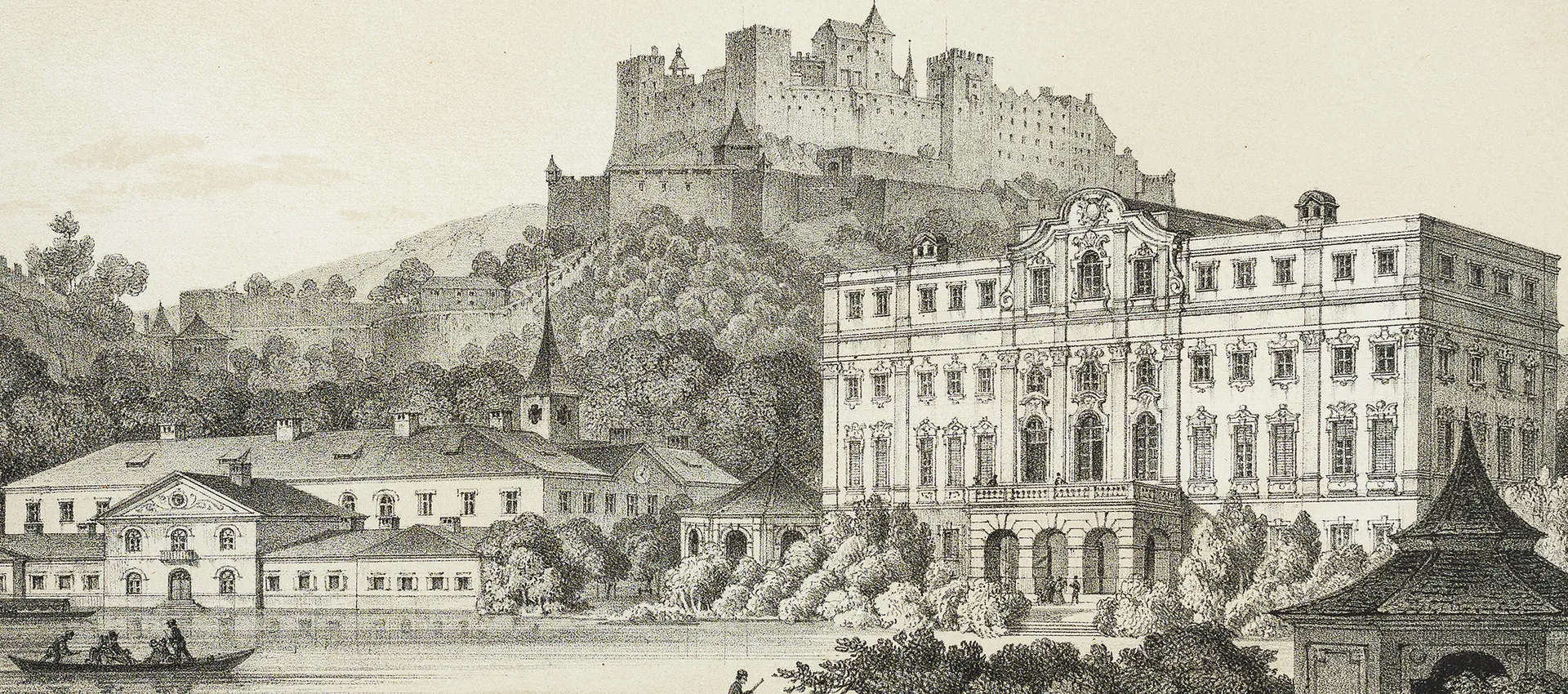
Schloss Leopoldskron was commissioned in the 18th century by Leopold Anton von Firmian, Prince-Archbishop of Salzburg, as a family estate marked by flair and grandeur. Built between 1736 and 1740, the palace was designed by the Scottish Benedictine Monk, Bernhard Stuart, not merely as a residence, but as an expression of human creativity and social aspiration.

Firmian wanted to position his family within a modern and elite European cultural tradition, and his Schloss reflected that outlook. The palace interiors were enriched with classical references, while the surrounding landscape - lake, gardens, and distant mountains - became an integral part of the experience. Nature was not framed as decoration, but as dialogue.

One of the most striking expressions of this vision is found in the sculptural programme, including the figure of Antinous. Rooted in classical mythology, it speaks to beauty, memory, and idealised form - a quiet assertion of humanist values at a time when power was often expressed through excess rather than thought.

Under Firmian, Leopoldskron was a place where symbolism mattered. Architecture, art, and setting worked together to convey meaning - an approach that would echo through the Schloss’s later incarnations.

03
Our History
Change, decline, and uncertainty

The Lost Years

The 19th century brought instability. Following the secularisation of Salzburg and the political upheavals that reshaped Europe, Schloss Leopoldskron passed through many hands. Owners arrived with differing ambitions - artistic, commercial, practical - but few were able to sustain the palace’s original spirit or resources.

Collections were dispersed, interiors altered, and elements of the Schloss’s original fabric lost. At various points, Leopoldskron was imagined as a spa hotel, a restaurant, or a speculative enterprise. These reinventions, often well-intentioned, gradually eroded the coherence of the place.

Yet even during these unsettled decades, the Schloss remained a presence – its silhouette beside the lake unchanged, its atmosphere lingering. Though diminished, it endured, waiting for a figure capable of re-imagining it not as a commodity, but as a cultural home.

04
Our History
A home for creativity and encounter

The Max Reinhardt Era

That figure arrived in 1918, when Max Reinhardt, one of the most influential theatre directors of his time, acquired Schloss Leopoldskron. Reinhardt saw in the palace more than a residence; he recognised a stage for ideas, collaboration, and artistic exchange.

He restored the Schloss with sensitivity and imagination, blending historic grandeur with new creative energy. Writers, actors, composers, and thinkers gathered here, and Leopoldskron became inseparable from the cultural life of Salzburg. It was during this period that the Salzburg Festival was born, with the Schloss at its intellectual heart.

Reinhardt lived the palace intensely. He famously said that he had “lived every room” - a sentiment that captures how deeply the place became entwined with his creative life. Leopoldskron was not a backdrop, but an active participant in the work that unfolded within its walls.

05
Our History
Expropriation, silence, and survival

Nazification & the Second World War

The rise of National Socialism brought this vibrant era to a violent end. As a Jewish artist, Reinhardt was forced into exile, and Schloss Leopoldskron was confiscated by the Nazi regime in 1938 – one of the earliest and most prominent acts of expropriation in Austria.

During the war years, the palace was subjected to ideological misuse and material loss. Furnishings were inventoried, collections seized, and the Schloss repurposed to serve the interests of the regime. Bombing raids damaged parts of the estate, and the atmosphere of cultural exchange was replaced by fear and silence.

Yet even in these darkest years, the Schloss was not destroyed. Its structure endured, its gardens remained, and fragments of its earlier spirit were preserved - sometimes quietly, sometimes by chance - allowing for the possibility of renewal after the war.

"I have lived in Leopoldskron for eighteen years, truly lived, and I have brought it to life. I have always loved it in a festive way, not as something ordinary. Those were my most beautiful, prolific and mature years ... I have lost it without lamenting. I have lost everything that I carried into it. It was the harvest of my life’s work."
Max Reinhardt, in a letter to his wife written in 1938
06
Our History
Dialogue, responsibility, and renewal

The Salzburg Global Era

In 1947, Schloss Leopoldskron entered a new chapter with the arrival of what would become Salzburg Global. Founded in the aftermath of war, the initiative brought young people from across Europe and beyond together to rebuild trust through dialogue, learning, and shared experience.

The palace once again became a place of encounter. Former adversaries sat side by side in discussion, using the Schloss as a setting for honest exchange and intellectual courage. The atmosphere - shaped by history, beauty, and reflection - proved uniquely suited to this purpose.

Over the decades, Salzburg Global evolved into an internationally respected forum, addressing issues from human rights and governance to media, health, and education. While the world changed, the Schloss remained constant: a place where conversation matters, and where individuals are invited to think beyond themselves.

Today, Schloss Leopoldskron stands as both historic landmark and living institution – a place shaped by its past, yet always oriented toward the future.

MORE

Link copied to clipboard
The Logo of Schloss Leopoldskron
  • Team
  • •
  • Sustainability
  • •
  • Jobs
  • •
  • Contact
  • •
  • Data protection and privacy notice
  • •
  • Dogs
  • •

© 2026 Schloss Leopoldskron. All rights reserved.

  • Terms and Conditions
  • Data Protection
salzburgglobal heritagehotelsofeurope umweltzeichen ECOLABEL
favicon